Artificial Intelligence (AI)
Artificial Intelligence (AI) refers to the simulation of human intelligence by computers—essentially enabling machines to learn, reason, and make decisions similar to humans. The concept of AI began as a research project in the 1950s and saw significant development during the late 1980s and early 1990s. Early AI programming was often done using languages like LISP and PROLOG.
Machine Learning (ML)
Machine Learning (ML) is a subset of AI focused on recognizing patterns and identifying outliers within data. This capability makes ML particularly valuable in fields like cybersecurity. ML gained prominence and widespread use starting in the 2010s.
Deep Learning (DL)
Deep Learning is an advanced form of ML that uses neural networks to mimic the way the human brain processes information. These networks consist of multiple layers—hence the term "deep"—which allow the system to learn complex patterns. Deep Learning models are somewhat unpredictable, similar to the human brain. This technology also rose to prominence in the late 2010s.
Generative AI (GenAI)
Generative AI represents the latest and most significant advancements in artificial intelligence, especially emerging in the 2020s. A key concept here is Foundation Models (FM)—large-scale models trained on vast amounts of data to understand and generate content. A prime example is Large Language Models (LLMs), which analyze language patterns to predict and generate text, ranging from the next word to entire paragraphs or documents.
Think of it like an advanced autocomplete system: instead of just predicting the next word, these models can generate coherent and contextually relevant sentences, paragraphs, or even full documents. This ability to create new content is why these technologies are called "generative."
Some critics argue that Generative AI isn’t truly creative but rather recombines existing information in new ways. To illustrate, consider music: every note has already been invented, yet composers create new songs by rearranging these notes in unique ways. Similarly, Generative AI produces novel outputs by reassembling learned information.
Generative AI and Foundation Models have been evolving rapidly, with notable breakthroughs around 2022.
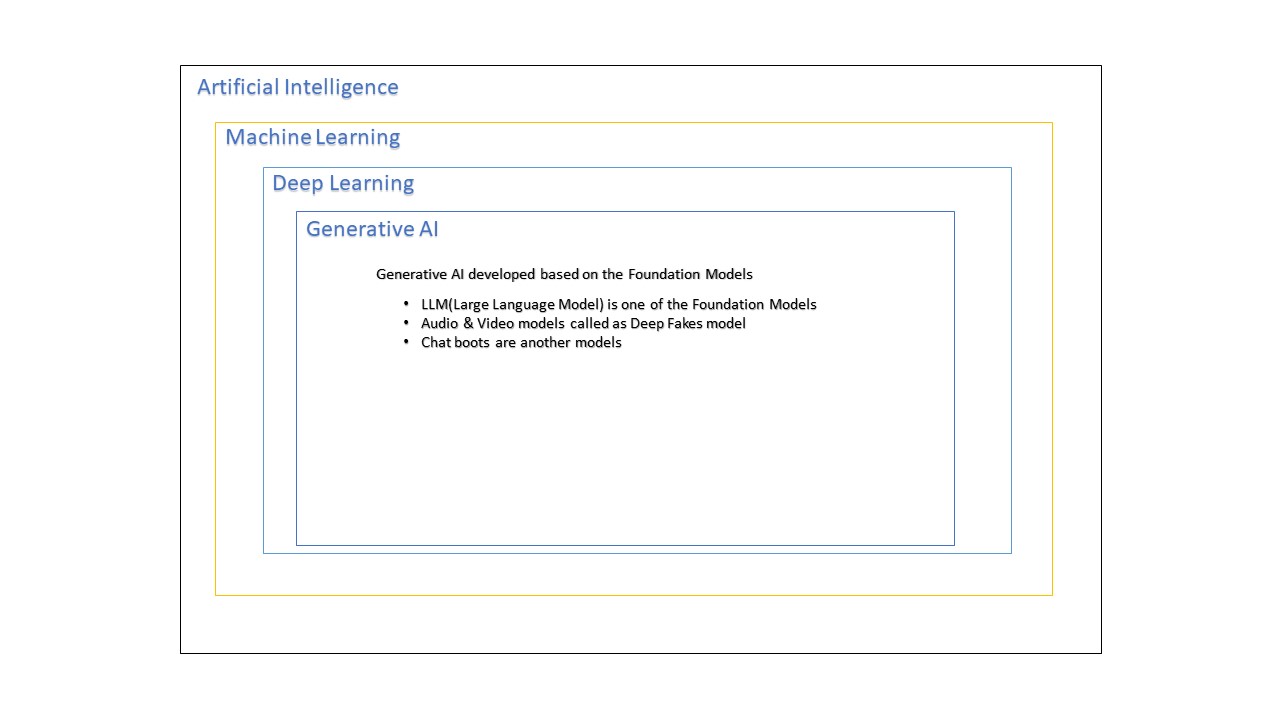
The above diagram will give you more understanding of the GenAI and diference of the AI, ML, DL and GenAI